If water is coming up through your basement floor drain right now, start here: stop using water anywhere in the house. Every flush, shower and load of laundry goes down the same pipe and comes out at the lowest opening, which is usually that floor drain. Once nothing more is going in, a backup usually stops getting worse.
My sewer is backed up. What should I do?
Work through these steps in order. None of them needs tools.
- Stop all water use. Tell everyone in the house, and stop the washer or dishwasher if either is mid-cycle.
- Stay clear of the water if it is near an outlet, an extension cord, the furnace or the water heater. Only switch off a breaker if you can reach the panel while standing on dry floor. If you can't, stay out of the basement.
- Treat the water as sewage. Wear rubber boots and gloves, keep children and pets upstairs, and wash your hands after touching anything the water reached.
- Don't pour chemical drain cleaner into the drain. It won't shift a blockage in the main line, and it makes the water more hazardous for whoever clears the pipe.
- Leave the cleanout cap closed. If the line is full, opening it releases the backed-up sewage all at once.
- Ask a neighbour or two whether they have the same problem. If several houses on the street are backing up, the blockage may be in the City's main sewer under the road. Only City crews can clear that, so contact the City of Guelph.
- Before you move or throw anything out, take photos and video of the water, how high it reached and what it touched. Your insurance company will ask for them.
- Lift what you can off the floor, and open a window if it is safe to do so.
If your house is the only one affected, the blockage is almost certainly in your own drain, and that calls for an emergency plumber.
What does a sewer backup look like?
It doesn't always start as a flood. The early signs are easy to miss:
- Water rising in the basement floor drain, especially when the washing machine empties or someone flushes a toilet upstairs
- Toilets gurgling, or the water in a bowl rising and falling by itself
- Several drains running slowly at once, especially the lowest ones in the house
- A sewer smell in the basement that wasn't there before
- Water around the base of a basement toilet or collecting in a basement shower
One slow sink is usually a local problem, such as hair, grease or a clogged trap. When several fixtures slow down together, or the lowest drain in the house starts to fill, the problem is in the main line between the house and the street, and you shouldn't wait on it.
What is the most common cause of sewer backup?
The City of Guelph says most sewer backups happen because a line is plugged. Unusually heavy rain can also cause them, especially in spring, when melting snow adds to the water already in the ground. So a backup comes from either something blocking the pipe or more water than the pipe can carry. What blocks the line depends a lot on when your house was built.
Houses in St. George's Park, Exhibition Park, The Ward and the Brooklyn and College Hill district are Guelph's oldest, dating from the 1850s to the early 1900s. They were typically built with cast-iron stacks and a clay sewer pipe out to the street. Clay joints crack over time, tree roots grow into the cracks, and then the roots catch whatever comes down the line. Many of these basements also have a floor drain that runs straight to the sewer, with no weeping tile and no valve. When the sewer can't take any more water, that drain is where it comes up.
After the Second World War, bungalows and storey-and-a-half houses filled the city's edges. Neighbourhoods then grew around Speedvale, Willow West and Stone Road and south of College Avenue through the 1960s and 70s. Many of these post-war houses have a clay or bituminous-fibre sewer pipe to the street. Fibre pipe loses its round shape with age and can collapse, clay joints let roots in, and the cast iron inside the house is getting old. Weeping tile was often tied into the sewer as well, so in a heavy rain or a spring thaw the water draining from around the foundation pours into the same pipe as the toilets.
In houses of any age, grease poured down the kitchen sink and wipes flushed down the toilet build up where a pipe sags or a root has got in. Wipes labelled flushable are still a common culprit.
Who is responsible for which pipe?
In Guelph, the property owner is responsible for the building sewer and the private drain all the way to the main sanitary sewer under the street, not just to the property line. The City clears blockages in the main itself. So if your neighbours are dry and your drain is backing up, arranging the repair is up to you, even when the problem is under the road allowance.
What will a camera inspection show?
Once the line has been cleared with a cable or with water jetting, a camera can go down the drain to show what caused the blockage. It might find roots at a clay joint, a flattened section of fibre pipe, a sag that holds water, heavy scale inside cast iron, or a sound pipe that just had something stuck in it. If the line is sound and the blockage was a one-off, clearing it may be all you need. If roots keep coming back, or the pipe is cracked or collapsing, drain cleaning will only buy time. The footage lets you see that for yourself before you decide on a repair.
How do you know if your home has a backwater valve?
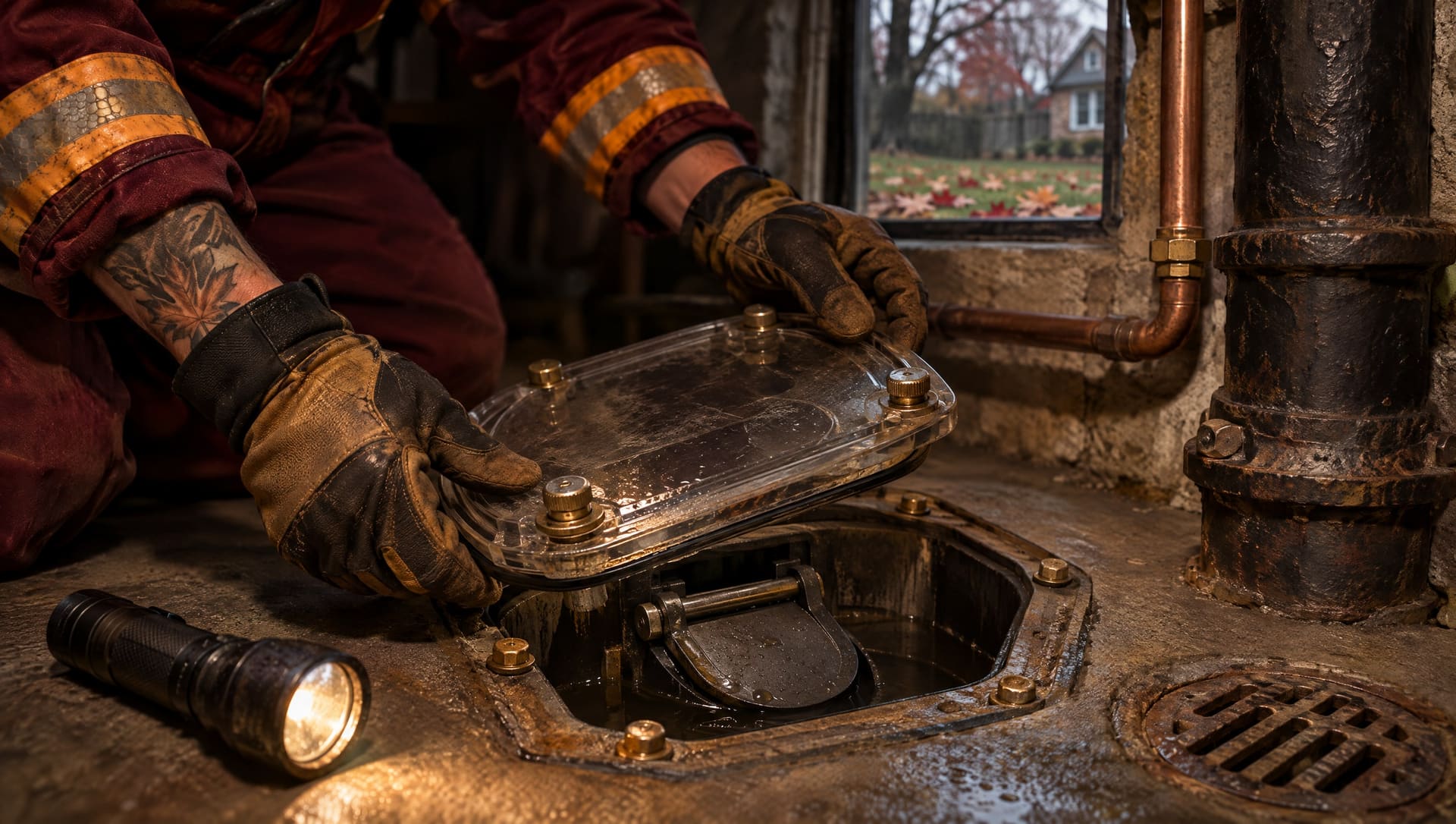
A backwater valve is a flap fitted in the main drain. It lets sewage flow out of the house and closes when sewage tries to flow back in. To check whether you have one:
- Look at the basement floor, usually near the wall where the sewer pipe leaves the house, for an access cover set into the concrete. It is often a round or square plastic lid.
- Lift the cover. Underneath, a valve has a clear or removable cap on top of the pipe, and you may be able to see the flap inside.
- Look through any paperwork from past renovations, or ask the City's building department about permits issued for your address.
If you find nothing, assume you don't have one. Many older Guelph houses, especially the ones with a floor drain run straight to the sewer, were never built with one. A rubber plug or ball check in the floor drain is not the same as a valve on the main drain.
Ontario's Building Code (Part 7, Article 7.4.6.4) calls for a backwater valve in new construction where a drain may be subject to backflow. That covers drains from fixtures below the level of the adjoining street, and fixtures below the upstream sanitary manhole cover in a house served by a public sewer. If you have a toilet, shower or floor drain below street level, that description may fit your house.
A valve needs looking after. Lift the cover now and then and clear out any debris, because a flap that is held open won't close. Also remember that while the valve is closed, your own water can't leave the house either, so keep water use low during a heavy storm.
Can I install a backflow preventer myself?
In practice, no. Plumbing is a compulsory trade in Ontario. To do the work, a person must hold a Certificate of Qualification or a provisional certificate, or be a registered apprentice, and must appear on the Skilled Trades Ontario Public Register. Putting a backwater valve on the main drain also means cutting the basement floor, opening the building drain and fitting the valve to the Building Code. Changes to drains generally need a building permit, and the City's building department will tell you whether yours does and will inspect the work.
If the job involves digging outside, someone must request a locate through Ontario Dig Authority before digging starts. Public locates don't mark private lines, and that includes your own sewer.
"Backflow preventer" can also mean a device that protects the drinking water supply, which is a different job. Make sure you and the plumber are talking about the same thing.
When you talk to a plumber, ask who will pull the permit, ask to see the camera footage and get the price in writing before work starts. At Guelph Plumbing Co, work is performed by licensed plumbers (306A Certificate of Qualification), and you approve the written price before any part is fitted.
To plan a backwater valve or a repair to the drain under your lawn, see sewer repair and backwater valves.